What Paint Has the Most Titanium Dioxide? A Practical TiO2 Guide
Discover which paints carry the most titanium dioxide, how TiO2 affects opacity and coverage, and how to read data sheets to choose high TiO2 white paints for homes or cars.


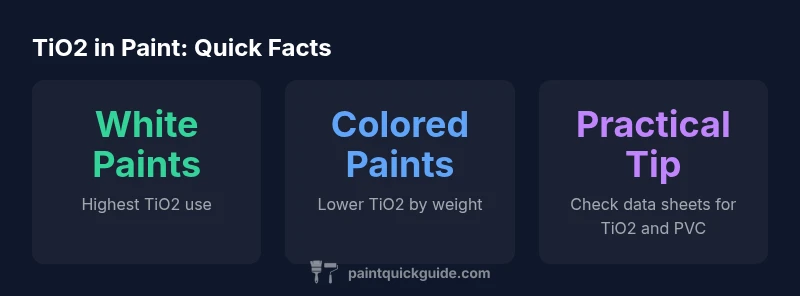
The highest titanium dioxide content is typically found in high-opacity white paints and primers, not colored paints. In practice, premium exterior and interior white bases, as well as specialty primers, use the most TiO2 by weight to maximize opacity and brightness. Colorful topcoats rely on smaller TiO2 quantities blended with other pigments, resulting in lower overall TiO2.
What TiO2 Really Does in Paint and Why It Matters
Titanium dioxide acts as the primary white pigment in many paints, delivering brightness and hiding power. In most residential and automotive coatings, TiO2 particles scatter light so effectively that fewer coats are needed to achieve uniform coverage. The pigment also helps stabilize color in many white and light tones, reducing the risk of yellowing or dulling over time. The scientific principle is simple: more TiO2 typically means more opacity, brighter white, and better color retention, but it comes with higher cost and potential formulation considerations. For DIY and professional projects alike, understanding TiO2’s role helps when you compare brands and lines for a given job.
Two crystalline forms dominate TiO2 pigments: rutile and anatase. Rutile is the more common choice for durable, high-opacity paints due to its superior brightness and weather resistance. Anatase is sometimes used in specialty coatings or lower-cost products. The choice of form, particle size, and surface treatment all influence hiding power and gloss. When you see high TiO2 claims on a label, you’re often looking at a formulation built around a white base designed to maximize light scattering rather than introduce vivid color.
How TiO2 Content Is Specified and Measured
Manufacturers often report TiO2 content by weight as a percentage of the total paint formulation. Some technical data sheets cite pigment solids or pigment volume concentration (PVC), which factors TiO2 not just by weight but by how much space the pigment takes up in the dried film. Because TiO2 distribution and particle technology vary across eras and brands, you’ll see a broad range of values across products. The most informative sources are the product’s technical data sheet (TDS) and the safety data sheet (SDS), where TiO2 content, grind size, and dispersion stability are described. When comparing products, look for two numbers: TiO2 by weight and PVC, then assess how each translates into opacity, whiteness, and longevity.
Which Paint Categories Tend to Have the Most TiO2
In general, high-opacity white bases and primers showcase the strongest TiO2 content. Exterior and interior whites used for ceilings, walls, and trim tend to emphasize TiO2 to achieve uniform brightness and camouflage previous coats or wall imperfections. Colored paints—reds, blues, greens—rely on other pigment blends and typically carry less TiO2 by weight because opacity demands are spread across multiple pigments. Specialty white-decorative coatings and primers often push TiO2 content even higher to ensure cover and stain resistance across surfaces.
Home vs Car Paint: TiO2 Content Differences
Home paints and car refinishes serve different functional goals. Household paints prioritize long-term opacity and weather resistance in a broad range of lighting conditions, which often means higher TiO2 content in white bases. Car paints, particularly basecoats and clearcoats, balance TiO2 with metallic, pearlescent, and specialty pigments to achieve the desired color effects and depth. As a result, car color coats may show lower TiO2 percentages than white home paints, while certain car primers and undercoats still rely on TiO2 to improve spreading and hiding power.
How Formulations Use TiO2 for Opacity and Brightness
Practical paint formulation uses TiO2 not only to whiten but to stabilize the film structure. Higher TiO2 loads improve opacity, but they can also affect viscosity, hiding time, and gloss. Formulators compensate with binders, dispersants, and particle treatments to maintain workability. In some lines, manufacturers trade off a portion of TiO2 for alternative fillers to target a specific drying time or finish. The key takeaway for consumers is that TiO2 content contributes to coverage and brightness, but the end result depends on the full formulation, not TiO2 alone.
How to Read Technical Data Sheets for TiO2
A TDS will typically list TiO2 content as a percentage by weight and may also specify PVC. Look for the type of TiO2 used (rutile vs anatase), particle size, and surface treatment. Additional notes on opacity, gloss, weather resistance, and recommended applications help you choose the right product. If you’re comparing two white paints, a higher TiO2 percentage is usually associated with greater hiding power, but confirm with the PVC and grind data for a fair comparison.
Practical Pick: Maximizing Coverage Without Waste
For projects prioritizing coverage and brightness, look for high-opacity white bases or primers with elevated TiO2 content, then verify if the product is designed for your substrate. If color accuracy or tint strength is essential, you may not want to push TiO2 to the extreme, since extremely high TiO2 loads can complicate tinting and reduce color vibrancy. In practice, balance TiO2 with binder quality, film thickness, and application technique to achieve the best results at the lowest cost.
Typical TiO2 content ranges by paint category
| Paint Type | TiO2 Content (range) | Typical Use |
|---|---|---|
| White interior latex | 40-70% | Ceiling and walls with good opacity |
| Exterior acrylic latex | 50-65% | Weather-exposed exterior surfaces |
| Bright white primer | 60-75% | Undercoat and stain blocking |
| Colored topcoat | 10-30% | Accent colors with pigment blends |
Your Questions Answered
Which type of paint has the highest TiO2 content?
High-opacity white paints and primers typically contain the most TiO2 by weight. These products prioritize whiteness and hiding power to improve coverage on large surfaces.
High-opacity white paints and primers usually carry the most TiO2, which helps them cover better.
Can I tell TiO2 content from the color name alone?
No. Color names don’t reveal TiO2 content. Always check the technical data sheet or safety data sheet for TiO2 by weight and PVC values.
Color name isn’t enough—check the data sheet for TiO2 by weight.
Does more TiO2 always mean better coverage?
Generally yes, but there are diminishing returns and tradeoffs with drying time, gloss, and tint strength. Look at TiO2 along with PVC and binder quality.
More TiO2 usually helps, but the gains level off and you face other tradeoffs.
Is TiO2 safe for household use?
Yes, TiO2 is widely used in consumer paints and is considered safe when handled according to product instructions. Avoid inhaling pigment dust during sanding and use proper PPE.
TiO2 is generally safe in household paint if you follow normal safety guidelines.
Are automotive paints the same as home paints for TiO2?
Automotive basecoats balance TiO2 with metallic, pearlescent, and color pigments to achieve depth and brightness, often resulting in lower TiO2 percentages in color layers compared to white home paints.
Car paints mix TiO2 with other pigments for color and depth, so TiO2 content isn't always higher than white home paints.
Where can I find TiO2 content on product labels?
TiO2 content is usually listed in the product’s data sheet or technical specification. If a label doesn’t show it, check the manufacturer’s website or request the TDS/SDS.
Look up the product data sheet or spec sheet for TiO2 content.
“Titanium dioxide content is a major driver of opacity, but the best outcomes come from considering the full formulation—binders, dispersants, and particle technology matter as much as TiO2 itself.”
Quick Summary
- Choose high TiO2 whites for max opacity and coverage
- Read data sheets for TiO2 by weight and PVC
- Expect colored paints to have lower TiO2 percentages
- TiO2 content interacts with binders and dispersants to affect finish
- Car paints balance TiO2 with metallic/pearlescent pigments