Paint Before or After Baseboards: A Practical Guide
A detailed, analytical comparison on whether to paint walls before baseboards or baseboards before walls, with masking strategies, time estimates, and step-by-step workflows for homeowners and DIYers.


TL;DR: For most interior projects, paint walls first and baseboards second to achieve crisper edges and easier masking. If you need to save setup time, you can paint baseboards first, but anticipate more touch-ups on walls and careful tape handling. The two orders have trade-offs in masking, edge quality, and total project duration.
Why the painting order matters for finish quality
According to PaintQuickGuide, the order you choose when painting interior trim and walls affects edge crispness, masking workload, and overall project duration. The simple question paint before or after baseboards isn't just about preference—it changes how you plan masking, how many touch-ups you'll perform, and how clean the final line between wall and trim looks. In most homes, the recommended approach is to paint walls first and baseboards second, but there are legitimate scenarios where painting baseboards first makes sense. Consider room type, finish, and timing. For example, if you're working with a light-wall color and a bright white baseboard, painting the walls first reduces the risk of baseboard smear from the masking process, while saving the wall surface from potential smudges later. Drawing on practical experience, the PaintQuickGuide team found that a well-planned sequence reduces rework and yields crisper edges.
In this guide we will break down the decision into concrete factors, compare outcomes, and give you a step-by-step workflow for both orders. We'll also discuss how to tailor the approach for different substrates, paint types, and room conditions.
-2
Comparison
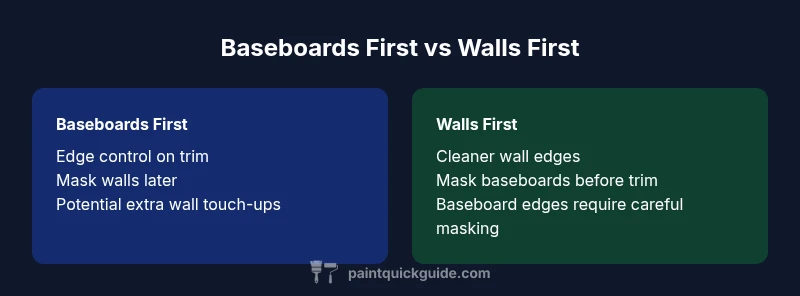
| Feature | Paint baseboards first | Paint walls first |
|---|---|---|
| Edge definition | Crisp baseboard edge possible; wall edge may require careful masking | Crisp wall-to-baseboard edge achievable with clean masking; baseboard edge depends on subsequent basecoat control |
| Masking workload | Moderate to high; protect walls during baseboard painting | Moderate to high; protect baseboards during wall painting |
| Drying and recoat windows | Baseboards dry quickly; walls may require longer complete cure | Walls often complete faster before baseboards are painted |
| Touch-ups | Possible baseboard touch-ups; more wall work after baseboards dry | Fewer wall touch-ups; more baseboard touch-ups after walls cure |
| Time/cost impact | Masking complexity can add time; project length depends on sequence | Masking around baseboards can add time; overall workflow often faster for walls first |
| Best for | Rooms where baseboard appearance is the priority or surface area is small | General interiors where walls are the focus and masking is well-controlled |
Upsides
- Potential for crisper edges with proper masking in either order
- Flexibility to adapt workflow to room layout and furniture placement
- Reduces risk of wall texture issues when walls are painted first
- Allows better color decisions on walls before committing to trim colour
- Can simplify touch-ups when baseboards are painted last
What's Bad
- Requires careful masking and tape handling in either order
- Increased masking steps can extend project duration
- Mistakes during masking can lead to paint bleed or edge chipping
- Baseboards-first can lead to more wall touch-ups if masking isn’t precise
Walls first is the generally recommended approach for most homes; it tends to yield crisper edges and fewer wall touch-ups, with masking tailored to protect trim.
Choose wall-first when walls are the dominant surface; opt for baseboards-first if you must capture a perfect trim edge early or when wall masking is difficult. The best choice balances edge quality, masking workload, and overall project time.
Your Questions Answered
What is the most common order for interior painting, walls or baseboards?
The most common approach is to paint walls first, then baseboards. This sequence minimizes the risk of brushing onto finished walls and allows for crisper baseboard lines with careful masking. It also gives you a straightforward path for touch-ups if needed.
Most homeowners paint walls first to keep walls clean and edges crisp with careful masking.
Does masking quality affect the decision of order?
Yes. The quality of masking largely determines edge cleanliness in either order. High-quality tape and precise cutting can make baseboards-first work, but walls-first still benefits from clean masking around baseboards.
Masking quality is key—great tape and careful cutting can compensate for the order you choose.
Can switching orders mid-project save time?
Switching orders mid-project can save time if you adapt masking and edge control on the fly, but it often increases risk of accidental drips and touch-ups. Plan the sequence before starting and minimize changes.
If you must change the order, proceed cautiously and expect some touch-ups later.
What about priming when painting baseboards first?
Priming is optional on new wood or stained trim. If painting baseboards first, use a compatible primer to ensure even coverage and reduce later staining on walls.
Primer helps even out color and finish, especially on bare wood.
How long should you wait between coats when changing order?
Follow the paint manufacturer’s guidelines for recoat times; in practice, allow sufficient dry time between coats on both walls and trim to avoid smudges and edge bleeding when you switch surfaces.
Let each coat dry fully before touching up or proceeding to the next surface.
Quick Summary
- Prioritize edge quality by planning masking around the chosen order
- Walls-first generally reduces wall touch-ups and damage risk
- Baseboards-first can help when trim edge perfection is critical
- Masking discipline and tape quality strongly influence results
- Choose the sequence based on room layout and project priorities