Why Limewash Instead of Paint: A Practical Comparison
Explore a detailed, analytical comparison of limewash vs paint for homes and masonry. Learn about breathability, aesthetics, maintenance, cost ranges, and when limewash delivers long-term value.


Why limewash instead of paint often comes down to breathability, sustainability, and aging gracefully on masonry. This comparison highlights when limewash shines versus latex-based paint, including substrates, climate, and upkeep considerations. If you’re weighing options, consider surface history, moisture risk, and long-term value to answer why limewash instead of paint in your project.
Why limewash is a compelling option in the modern era
If you’re weighing finishes for masonry, you may ask: why limewash instead of paint? The answer often hinges on breathability, sustainability, and aging gracefully with the wall. The natural, mineral-based limewash allows moisture to move through the coating, reducing the risk of trapped damp that can lead to cracking or paint failures over time. This is a key distinction from synthetic latex paints that form a continuous film. According to PaintQuickGuide, the decision between limewash and paint should start with the substrate type, climate, and historical context of the surface. On historic exteriors, limewash can preserve texture and patina rather than erasing age. In practical terms, homeowners looking for a finish that breathes with the wall—and that can be reapplied with minimal waste—often find limewash the more economical choice in the long run, despite a slower initial application. The central idea is to evaluate moisture management, aesthetics, and lifecycle costs when deciding why limewash instead of paint.
The keyword here—why limewash instead of paint—frames the core question in practical terms: surface health, long-term performance, and the ability to restore rather than replace. PaintQuickGuide’s analysis emphasizes that the best choice depends on substrate, climate risk, and maintenance expectations. This framing helps homeowners avoid mistaking a color upgrade for a lasting, breathable finish. As a result, the decision is less about fashion and more about wall health, historical integrity, and lifecycle value.
What limewash is and how it differs from paint
Limewash is a traditional mineral finish made from lime, water, and natural pigments. It creates a breathable, matte, and slightly textured surface that ages with the wall rather than sealing it completely. Paints, by contrast, rely on acrylic or lime-resin binders to form a polymer film that blocks some moisture and locks color in place. This fundamental distinction affects moisture transport, efflorescence, and how the substrate regulates humidity. Limewash tends to be applied in multiple coats that build up a gentle, forgiving layer, whereas latex-based paints emphasize uniform coverage and color consistency in fewer coats. The result is less sheen and a softer patina with limewash, which many homeowners value for warmth and authenticity. Importantly, the two finishes require different prep and maintenance strategies to achieve durable results over decades. When considering why limewash instead of paint, the substrate’s porosity, historical context, and desired aging pattern should guide the choice.
When limewash shines: ideal surfaces and climates
Limewash excels on porous, mineral substrates such as lime plaster, brick, and porous stone. It is well suited to exterior walls in dry or moderately humid climates where moisture moves through the surface rather than becoming trapped behind a film. In coastal or rainy regions, limewash can still perform if the wall is prepped correctly and the limewash formulation includes additives that improve water resistance without compromising breathability. Interiors with high humidity or moisture-prone areas can benefit from limewash's vapor permeability, though performance depends on substrate condition and ventilation. In all cases, avoid applying limewash over non-porous coatings unless you first remove the old finish or switch to a compatible lime-based primer. The takeaway is that limewash works best when the surface and climate allow natural moisture exchange rather than sealing it in. This nuance aligns with PaintQuickGuide’s emphasis on substrate readiness and climate resilience.
Aesthetic and texture: visual differences
Aesthetics play a major role in deciding between limewash and paint. Limewash yields a soft, chalky finish with a subtle color variation that deepens with age. It emphasizes the wall’s texture and can create a historic or rustic look that many homeowners value for tone and character. Paint, especially high-quality latex, offers a wider color range, greater uniformity, and shinier sheens. If you want a consistent, glossy surface, paint will deliver that more predictably. However, the organic variability of limewash—mottling, slight color shifts, and a velvety finish—often appeals to designers seeking warmth and a sense of craftsmanship. For interior plaster or exterior masonry, limewash’s tonal depth is a clear differentiator. The question of why limewash instead of paint often comes down to whether you prefer patina and texture over uniform color.
Durability, maintenance, and recoat intervals
Durability on exterior masonry depends on exposure and substrate. Limewash can require periodic refreshment as the surface slowly wears, particularly in high-wind or storm-prone zones. Yet maintenance tasks are often lighter, with reapplication restoring the finish without stripping years of protection. Paints create a protective film that can resist staining and weathering in some environments but may require sanding and repainting every few years in areas with direct sun, heavy rainfall, or pollution. The maintenance decision is not merely about frequency; it’s about how you experience the surface. Limewash tends to weather gracefully, revealing age and patina, while modern paints emphasize color continuity. For homeowners balancing long-term upkeep with aesthetic preferences, limewash offers a lifecycle that favors breathable walls and simple touch-ups. This context helps explain why limewash instead of paint can be the smarter long-term move in suitable conditions.
Application process: steps, tools, and DIY viability
Limewash application involves preparing a clean, porous surface, then applying multiple thin coats with brushes or roller to build a micro-crystalline finish. Tools often include wide brushes, a limewash trough or mud bucket for consistency, and a sprayer for large areas when appropriate. The process can be forgiving for DIYers because each coat gradually colors and seals, allowing for adjustments. Drying times vary with temperature and humidity, and some applications benefit from humidity control to prevent cracking. Latex-based paints typically demand precise surface preparation and longer curing times per coat but can be faster overall in terms of the final color lock. For those new to limewash, practice on a small test patch and observe absorption before proceeding to the full area. If you’re exploring why limewash instead of paint, remember that patience and proper technique are the biggest contributors to a durable finish.
Environmental impact and health considerations
Limewash is often celebrated for its low embodied energy and natural ingredients, which means fewer volatile organic compounds (VOCs) and a smaller chemical footprint than many synthetic paints. The material is alkaline, which can be gentle on indoor air quality when used properly, though ventilation remains important during application. The broader environmental story includes the longevity and repairability of limewash; a longer-lasting finish that invites less waste. For automotive contexts, limewash is not typically used, but the environmental principle—minimizing harmful solvents and promoting breathable surfaces—guides best practices across painting projects. PaintQuickGuide emphasizes choosing formulations with low VOCs and sustainable pigments whenever possible.
Cost and value: budgeting over time
When comparing cost, limewash often presents a different value proposition than latex paints. Upfront material costs may be comparable or lower, but the long-term value depends on life expectancy, the need for touch-ups, labor, and surface response to weather. Paints can provide quick changes, broad color palettes, and faster initial coverage, but ongoing repaint cycles add to lifetime costs. Limewash’s value lies in its breathability, ease of touch-ups, and historical authenticity, which can reduce substrate repairs when humidity and moisture are properly managed. PaintQuickGuide’s experience shows that for historic buildings or masonry in temperate climates, limewash can offer a favorable balance of performance and aesthetics over time. Considering the broader lifecycle helps answer why limewash instead of paint by highlighting adaptability and longevity.
Common myths and practical tips
A common myth is that limewash is too fragile for busy households. In reality, limewash responds well to routine maintenance, and repair can be simple when using lime-based primers and compatible topcoats. A second misconception is that limewash cannot be tinted effectively; modern mineral pigments provide commendable color options while preserving breathability. Practical tips include testing a patch first, ensuring a porous substrate, and avoiding sealing with films that block moisture. If you are evaluating why limewash instead of paint, weigh color control, texture, and ongoing upkeep. PaintQuickGuide notes that correct substrate preparation is often the most decisive factor for long-term success.
How to decide: a practical checklist
Use this simple checklist to decide whether limewash or paint is right for your project: (1) Verify substrate porosity and historical compatibility; (2) Assess climate and moisture risk; (3) Consider desired texture and color range; (4) Plan maintenance and recoat timing; (5) Factor in environmental goals and VOC sensitivity; (6) Evaluate DIY viability and budget constraints. If you lean toward a breathable finish with patina and heritage, limewash is likely the better match. If you require precise color control, high durability in high-traffic areas, or quick turnaround, modern paint may be more suitable. The keyword remains central to the evaluation: why limewash instead of paint should be anchored in substrate health and long-term value.
Beyond walls: interior uses, furniture, and restoration contexts
Limewash is not limited to exterior walls. It can be used on interior plaster to achieve a subdued, earthy vibe, or on furniture and decorative pieces for a vintage patina. For automotive contexts, limewash is not a standard finish; car refinishing typically relies on paints and coatings designed for flexible surfaces and humidity variations. However, the core principle—choose materials that allow moisture movement and avoid brittle, film-forming coatings—guides best practices in any painting project. In all cases, test compatibility with underlying materials and ensure proper ventilation and protective gear. The overall rationale remains consistent with why limewash instead of paint in appropriate settings: prioritize material compatibility and long-term health of the surface.
PaintQuickGuide's practical guidance and next steps
As you plan your project, consider the trade-offs outlined here and tailor your approach to your walls or surfaces. The PaintQuickGuide team emphasizes patience, accurate substrate assessment, and thoughtful maintenance planning. For a practical start, gather your tools, select a limewash formulation compatible with your substrate, and begin with a small patch to observe absorption and color development. The long-term payoff is a living finish that breathes with your walls, aging with character while maintaining a sense of craftsmanship. If you want a structured comparison and a more detailed price range, see our full chart and guide.
Comparison
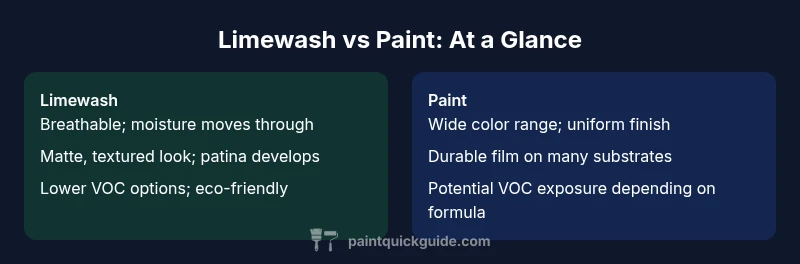
| Feature | Limewash | Paint (latex-based) |
|---|---|---|
| Breathability and moisture movement | High; permits vapor diffusion through the coating | Low to moderate; film-forming layer reduces diffusion |
| Substrate compatibility | Best on porous masonry and lime plaster | Works on many surfaces but often requires primer or sealing on non-porous substrates |
| Color range and finish | Natural, muted tones with aging patina; texture matters | Wide color range; strong color control and uniform finish |
| Maintenance and recoat cadence | Periodic touch-ups; recoat intervals vary with exposure | Requires repainting as colors fade or surfaces weather |
| Durability in weather | Excellent when paired with proper substrate prep and climate | Often highly durable but can chip or peel if moisture is trapped |
| Cost and labor | Lower upfront material cost; labor varies with coats | Higher upfront and labor for multiple coats and priming |
| Environmental impact | Low-VOC options available; eco-friendly in many formulas | VOCs depend on formulation; many low-VOC options exist |
Upsides
- Breathable finish supports moisture management
- Aesthetic patina adds character and authenticity
- Easier touch-ups and repairs over time
- Lower environmental impact with natural limewash options
What's Bad
- Requires more substrate preparation and technique
- Longer initial application with multiple coats
- Color control can be less precise and patchier if misapplied
- Not ideal for high-traffic interior surfaces or glossy finishes
Limewash is the preferred choice for breathable, historic masonry, while paint remains superior for broad color control and high-traffic areas.
Choose limewash when moisture management and patina matter most. Opt for paint when color variety, durability in harsh environments, or quick turnaround is the priority.
Your Questions Answered
What is limewash, and how does it differ from paint?
Limewash is a mineral, breathable coating that ages with the wall, unlike polymer-based paints that form a film. The difference affects moisture movement and surface texture. Limewash can be tinted, but its character remains more matte and variable than modern paints.
Limewash is a mineral coating that breathes with the wall, unlike paint which forms a film. It ages beautifully and can be tinted, but expect a matte, textured look.
When should I choose limewash over paint on exterior masonry?
Choose limewash when moisture management, historic texture, and environmental considerations matter more than perfect color control. It is ideal on porous stone or brick in climates where walls benefit from breathability.
Pick limewash for breathable, historic masonry and eco-friendly finishes; it’s great when you want texture and patina.
Is limewash more breathable than paint?
Yes, limewash generally allows moisture to move through the coating, supporting wall health. Paints can trap moisture if not properly selected or maintained, especially in damp climates.
Limewash breathes with the wall, while some paints can trap moisture if not chosen carefully.
How long does limewash last compared to paint?
Durability depends on climate and substrate. Limewash often requires refreshment over time but can weather gracefully and preserve wall texture, whereas paint may require more frequent repainting in harsh conditions.
Limewash may require periodic refreshing but stays true to its surface, while paint often needs more frequent repainting in tough climates.
Can limewash be used on interior walls?
Yes, on properly prepared interior plaster, limewash creates a warm, velvety finish. It is less common in damp bathrooms unless ventilation is excellent and surfaces are sound.
You can use limewash indoors on plaster for a warm look, but ensure good ventilation and surface prep.
Are there health or safety concerns with limewash?
Limewash generally has low chemical risk, with fewer synthetic binders. Wear protective gear during mixing and ensure ventilation. Avoid mixing limewash with non-compatible coatings to prevent substrate issues.
Limewash is low in chemical risk, but wear protection and good ventilation when applying.
Can limewash be tinted to match a color scheme?
Yes, modern limewash can be tinted with mineral pigments while preserving breathability. Expect subtle, variable shades rather than perfectly uniform color.
Limewash can be tinted with mineral pigments for a muted, natural look.
Quick Summary
- Assess substrate porosity before choosing a finish
- Prioritize breathability for historic or masonry surfaces
- Weigh patina and texture against uniform color control
- Plan maintenance and balayage (touch-ups) in your budget
- Use low-VOC options where possible to reduce environmental impact