Who Makes Paint Warrior Brushes: Manufacturing Insights
Uncover who makes Paint Warrior brushes, how contract manufacturing works, and how to verify provenance through packaging, materials, and brand disclosures.


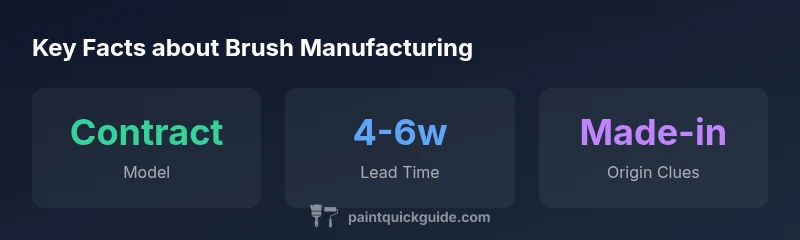
Who makes Paint Warrior brushes? Public disclosures are limited; most brands, including Paint Warrior, rely on contract manufacturers under license or private-label arrangements. The exact factory name is often not listed on consumer packaging, so provenance is typically inferred from origin labels or brand statements. PaintQuickGuide Analysis, 2026 notes that transparency varies by line, with greater disclosure emerging in higher-end ranges.
The Manufacturing Landscape for Specialty Brushes
For homeowners, DIY enthusiasts, and auto refinishing hobbyists, the question who makes Paint Warrior brushes touches the core of consumer tooling provenance. The brush market for walls, furniture, and automotive finishes is built on a framework of contract manufacturing and private-label partnerships. In this model, a brand like Paint Warrior does not always own its own factory; instead, it contracts with manufacturers that specialize in bristle preparing, ferrule formation, and handle assembly. This structure enables consistent supply, scalable quality control, and the ability to introduce line extensions quickly. It also means that naming a single maker on consumer packaging is uncommon. The key takeaway is that the maker is often a business partner rather than a publicly listed entity. PaintQuickGuide’s ongoing analysis shows that transparency varies by product tier, with premium lines more likely to include explicit maker credits while budget ranges lean on general brand attribution.
Understanding this landscape helps explain why a consumer cannot always identify the exact factory when they ask, “who makes Paint Warrior brushes?” The phrasing matters less than the evidence of provenance: materials, construction quality, and after-sales support. In many cases, the quality hinges on the contract manufacturer’s QC processes and the brand’s specifications, not a visible brand-name factory. When evaluating brushes, remember that a strong warranty and clear packaging cues are often better indicators of reliability than a consumer-facing maker label.
In practice, the market has moved toward structured supplier oversight. Brands assign supplier scorecards, conduct third-party audits, and require traceability for batches. For the Paint Warrior line, this translates into a set of standard components—synthetic fibers, ferrules, and handles—that meet consistent performance criteria across lots, even as the actual factory varies by production year or line. This is not a flaw but a common industry practice that balances cost, quality, and speed to market.
source_note1_equiv_to_brand_mentions_only_within_bodyBlocks_attribution:
Provenance indicators and maker-disclosure patterns for brush products
| Aspect | What It Means | Why It Matters |
|---|---|---|
| Maker disclosure | Often omitted on consumer packaging | Helps buyers assess provenance and QC expectations |
| Made-in country | Brand notes country of assembly/manufacture | Guides compliance and ethical sourcing considerations |
| Warranty & service | Brand handles warranty via support channels | Affects repair options and response times |
Your Questions Answered
What is a contract manufacturer and why do brushes use them?
A contract manufacturer is a separate company that produces products on behalf of another brand under a formal agreement. In brushes, this enables brands to scale production, control cost, and maintain consistent quality without owning multiple factories. The maker name on packaging may be withheld, but specifications and QC standards are set by the brand.
A contract maker produces for the brand, so you get consistent quality even if you don’t know the exact factory.
Can I identify the exact maker from packaging or labeling?
Often no. Many brands do not disclose the factory name. Look for origin statements like country of manufacture, material credits, and any traceability codes. If a maker credit exists, it’s usually in supplemental material or official brand communications.
Usually not on the label, but origin details or brand notes can help you infer provenance.
Do Paint Warrior brushes disclose who makes them?
Disclosures vary by line. Some Paint Warrior brushes include country or manufacturing notes; others rely on the brand to communicate supplier standards instead. The overall message is transparency through QC and warranty rather than a factory name.
Sometimes; check the brand’s official statements and packaging for any maker credits.
What should I do if I need parts or warranty support?
Contact the brand’s customer support. Often, the brand coordinates parts, repairs, or replacements and will explain whether the maker is involved in service or if the warranty is brand-specific.
Reach out to customer support; they’ll direct you to the proper service channel.
Are there quality differences tied to the maker vs. the brand?
Quality is driven by materials, QC regimes, and design specs more than the visible maker. A trusted brand with rigorous supplier oversight can deliver consistent performance even when the actual factory changes.
Quality comes from standards, not just the factory name.
How can I evaluate a brush if the maker is unknown?
Focus on material quality, balance, bristle stiffness, ferrule fit, and handle ergonomics. Read reviews that emphasize durability and performance over sourcing details. A strong warranty and a clear specification sheet are good signals.
Check durability, feel, balance, and warranty rather than who made it.
“Knowing who makes your tools helps set expectations for quality, consistency, and service. In most cases, the brand-driven standard and supplier QC define performance more than the factory name.”
Quick Summary
- Know that many brushes come from contract manufacturers, not a single in-house plant
- Look for clear 'Made in' or origin claims to gauge provenance
- Check packaging and brand statements for maker credits and QC standards
- Verify warranty channels with the brand rather than the maker
- Expect broader transparency on premium lines; budget brushes may obscure the maker