What Paint Color Is This? A Practical Identification Guide
A practical, data-driven guide to identify and match paint colors accurately across walls, cabinets, and cars—covering lighting, tools, swatches, and professional options.


Definition: 'What paint color is this' refers to identifying an exact color or the closest match from a paint line. The answer uses neutral lighting, photographs, color-matching tools, and swatch comparisons, plus practical checks to verify tones in real spaces. This quick guide outlines reliable methods for walls, cabinets, and auto finishes.
Understanding the request: what 'what paint color is this' really asks
The phrase 'what paint color is this' often signals a need to identify a specific shade or the closest match from a paint line. The reader is typically repainting a room, refinishing cabinets, or touching up a car, and accuracy matters. According to PaintQuickGuide, the best starting point is to separate hue from value (lightness) and chroma (saturation). Begin with a neutral daylight photo, then review the image with a workflow that combines physical swatches and digital tools. Capture images from several angles and distances to reveal undertones, such as warm cast in a white wall or a cool tone on gray cabinets. A reliable answer normally rests on multiple data points, not a single snapshot.
Lighting and photography: how color shifts and why it matters
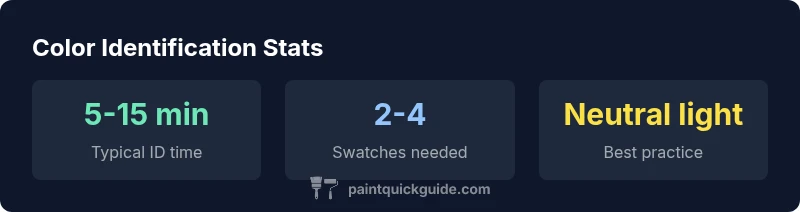
Color reads differently under varied lighting. Daylight (neutral white) is the most reliable baseline, but most spaces rely on artificial light during the day or evening. White balance, color temperature, and screen calibration all influence how a color appears in a photo. When identifying a paint color, start with a neutral, well-lit photo, then cross-check by viewing the image on another device and in natural daylight. This practice helps reduce misleading undertones and off-speeds the decision process.
Color-matching methods: swatches, apps, and chips
There are several trusted paths to color identification. Physical swatches or paint chips from a store provide a tactile reference that’s unaffected by screen color. Color-matching apps can quickly offer candidate matches, but they rely on your photo quality and the device’s color profile. For best results, compare at least two sources: a physical swatch and a digital match, then validate against a real patch under the same lighting.
Step-by-step: identifying color for walls, cabinets, or cars
- Photograph the surface in neutral daylight, then capture at least three close-up swatches. 2) Gather two to three swatch families (chips, fan decks, or a color-m Blatt) from trusted brands. 3) Use a color-matching app to shortlist candidates, then request official color codes from suppliers. 4) Print test patches and apply a small swatch in the space; observe at different times of day. 5) Record the exact color name or code for future touch-ups.
Common pitfalls and how to avoid them
Avoid relying on a single photo or a phone screen. Lighting, glare, and camera profiles can skew results. Do not assume a color name equals a code. Always confirm with official chips or a store’s color-matching system. When in doubt, repeat the process with a second device and one more swatch.
Choosing the right color system: RGB, CMYK, and paint color codes
Color systems differ: RGB is screen-based, CMYK is printing, and paint codes are the practical frame for real finishes. Translate digital candidates to physical paint swatches using the brand’s color codes (e.g., swatch or fan deck). If you must compare, keep a reference chart mapping digital colors to manufacturer codes to minimize mis-match.
Practical tips for matching and saving colors
Keep a color-identification log: photo, surface, lighting, brand, code, and finish. Save swatch photos with metadata and names, and store a sample patch in your project folder. Consider creating a small mood board listing candidate colors and the contexts in which they work best—wall color, cabinetry, or car refinishing.
When to trust or double-check professional help
If a perfect match is critical (custom cabinetry, high-value car refinish), work with a certified color-matching service or a paint store specialist. They can verify with equipment like spectrophotometers and provide an official color code for production.
Color-identification options and their trade-offs
| Method | Pros | Cons | Best Use |
|---|---|---|---|
| Color-matching app | Fast and convenient | Lighting and screen color can mislead | Quick spot checks and on-the-go references |
| Physical swatches / chips | Highly reliable reference under proper lighting | Time-consuming and may require many swatches | In-store or at home with consistent lighting |
| Paint-store color-matching service | Professional accuracy, large color libraries | Cost and turnaround time | When a precise match is required (cars, cabinetry) |
| Photograph-based identification | Record-keeping and comparison across spaces | Dependent on camera and environment | Initial identification and documentation |
Your Questions Answered
How accurate is color identification from photos?
Photo color can be misleading due to lighting and screen contrast. Use multiple sources and verify results in person under neutral lighting.
Photo color can mislead; verify in person under neutral light.
Can you identify car paint color exactly?
Car finishes include clear coats and metallics that complicate matching. Use professional color matching and check official codes.
Car paints are tricky; use professional matching and codes.
What tools improve accuracy?
Color-matching apps, paint chips, and store swatches work best when used together under neutral lighting.
Apps and chips under neutral light improve accuracy.
Does brand matter for color matching?
Brand color systems differ; cross-reference codes and request official chips to avoid mis-match.
Brand codes vary; compare across brands.
How to test a color in a room?
Paint a small patch and observe under daylight and artificial light before committing.
Test patches under different lights before deciding.
What is the best way to store color IDs for future work?
Save color codes, supplier, finish, and photos for easy touch-ups later.
Keep notes and swatches for future touch-ups.
“Color identification is as much about context as hue. Lighting, materials, and surface finish dramatically shape how a color reads.”
Quick Summary
- Start with neutral lighting and multiple photos
- Use a mix of physical swatches and digital tools
- Test patches in the actual space under varied lighting
- Record color codes, brands, and finishes for touch-ups
- Follow a repeatable workflow to minimize guesswork