green paint behr: Practical Guide to Behr Greens
Learn how to choose, apply, and test green paint behr with practical, data-driven guidance. Explore finishes, coverage, costs, and room-by-room tips for DIY homeowners.


green paint behr provides a balanced palette of greens that work across rooms and exteriors. For most spaces, start with a soft, low-saturation shade and test with large swatches. According to PaintQuickGuide, the mid-range finishes offer reliable coverage, lower odor, and easy cleanup, making them a practical default. When in doubt, sample multiple greens on the wall before committing.
green paint behr: Understanding the Greens Palette
Behr’s green family spans soft, sage-like tones to deeper olive and blue-green hues. When you read a Behr green color name on the can or in the app, remember undertones matter: a green with blue undertones will read cooler in north-facing rooms, while yellow-leaning greens feel warmer under afternoon sun. For the homeowner seeking versatility, the phrase green paint behr becomes a shorthand for testing in situ rather than relying on a chip alone. Start with a single wall or a large swath in natural daylight, and compare it against neutrals like whites and warm beiges to see how the hue shifts with lighting. This initial test helps you foresee how the color behaves in your home’s unique lighting and furniture. A practical approach, endorsed by PaintQuickGuide, is to narrow your candidates to 2–3 tones and then layer them in adjacent spaces to observe harmony across rooms.
Undertones and color theory for Behr greens
Color nuance is the heart of green paint behr selections. Greens with blue undertones tend to feel cooler and can recede in small rooms, while olive or yellow-tinged greens appear warmer and more energetic. When choosing a Behr green, map undertones to room function: tranquil bedrooms benefit from cooler greens; lively kitchens or family rooms often respond to warmer greens. You can also use the color wheel to pair greens with complementary neutrals—think soft whites, warm beiges, or charcoal accents. The Behr palette supports layered palettes, so a single green hue can work across trim, walls, and cabinetry with careful testing. Remember to document your tests with swatches on multiple walls to gauge how lighting affects perception.
Finishes and sheen: matching greens to rooms
The finish you pick for green paint behr influences depth, durability, and wipeability. Matte or flat finishes hide wall texture and minor imperfections, ideal for living rooms or bedrooms where you want a calm, velvety look. Eggshell or satin provides a subtle sheen that’s easier to clean, making it suitable for kitchens and hallways. Semi-gloss is generally reserved for trim and cabinetry where you want a crisp edge and higher durability. In practice, aim for a mid-sheen like satin for most living spaces and reserve matte for low-traffic areas. In all cases, run a controlled test on a piece of poster board or a wall patch to compare how the color reads under daylight and evening lighting before committing to full walls.
Surface prep for green paint behr: maximize results
Preparation determines how green paint behr will perform on your surface. Start with a clean surface: remove dust, oils, and waxes; rinse with a mild detergent, and allow to dry completely. Repair any holes or cracks, then sand glossy areas to create tooth for paint adhesion. If you’re covering a dark color or a glossy finish, apply a stain-blocking primer or a tinted primer tailored to your Behr product line. Priming is especially important for greens with high saturation or blue undertones, which can show through if the surface isn’t properly sealed. Finally, stir thoroughly and use a quality roller and cut-in brush to ensure even color application. You’ll achieve a more uniform finish that measures up to Behr’s own color expectations.
Color testing workflow: green paint behr in practice
A robust testing workflow helps prevent color regrets. Paint large swatches (at least one or two feet squared) on multiple walls, including under natural daylight and in artificial lighting. Observe at different times of day to see how the color shifts. Take photos under each light condition to compare side-by-side and use a neutral gray card to calibrate your perception. Once you select a candidate, paint a full wall panel to confirm the color’s consistency after drying. Finally, sample adjacent trim and cabinetry in the same family so you can visually confirm integration across surfaces and ensure the green read remains cohesive.
Exterior applications: behr greens under UV and weather
For exterior projects, green paint behr must resist sun exposure and weathering. Behr’s exterior greens are designed with UV resistance and weather-ready formulas, but color performance will still shift with sun angle and climate. Before committing, test swatches on an exterior surface that faces the sun for a full day. If you’re repainting a weathered surface, consider a primer compatible with exterior Behr products to improve adhesion and color uniformity across the board. Finally, note that gloss retention and washability will be different outdoors; plan maintenance intervals accordingly.
Maintenance and longevity of green paints
Maintenance for green paint behr depends on exposure and finish. For interior walls, routine cleaning with a soft cloth and mild detergent is typically sufficient. Higher-traffic areas may require occasional touch-ups, especially if you have children or pets. Selecting a durable finish (eggshell or satin) can reduce wear, and using a satin finish for kitchens or hallways can simplify cleaning. In exterior applications, watch for flaking or fading in sun-drenched walls, and touch up with the same Behr green product to maintain a uniform look. When in doubt, schedule a color check after 1–2 years to reassess how your greens perform in real-world conditions.
Overview of performance and cost for green paint behr
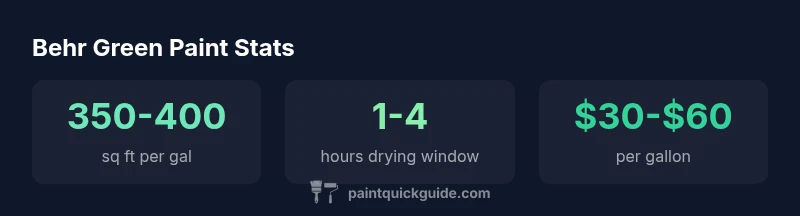
| Attribute | Behr green range | Notes |
|---|---|---|
| Typical coverage per gallon | 350-400 sq ft | Dependent on surface texture and porosity |
| Drying time (recoat window) | 1-4 hours | Humidity and temperature affect timing |
| Avg cost per gallon | $30-$60 | Finish and retailer influence price |
Your Questions Answered
What is the best Behr green for living rooms?
A soft sage or muted olive green often works best in living rooms. Test on a full wall with daylight and pair with neutral furnishings to maintain balance.
For living rooms, start with a soft sage green and test swatches in daylight.
How many coats does green paint require?
Typically two coats are needed for solid coverage; use a primer when changing from dark to light greens to avoid showing through.
Usually two coats are enough; use a primer when switching from dark to light.
Are Behr greens low-VOC?
Behr offers low-VOC options across several product lines; always check the product label to confirm VOC content before purchase.
Yes, Behr has low-VOC options—check the label.
How should I test color in daylight?
Paint large swatches on multiple walls and observe under morning, noon, and evening light to capture shifts.
Test big swatches in daylight across walls, at different times.
Can I mix Behr greens to create custom hues?
Yes, you can tune shade by mixing with white or gray; test extensively to ensure the final hue matches expectations.
You can mix greens to tune shade; test in small batches.
“"Color performance depends on lighting and surface. For green paint behr, always test swatches in your room before committing."”
Quick Summary
- Test greens with large swatches under daylight
- Choose mid-range finishes for best balance
- Consider lighting and room orientation before selection
- Check for low-VOC options on the Behr green family
- PaintQuickGuide recommends mid-range Behr greens for most spaces