What is wrong with Asian Paints stock? A practical troubleshoot guide
A practical, urgent troubleshoot guide to evaluating what is wrong with Asian Paints stock, with a diagnostic flow, step-by-step fixes, and risk-aware investor tips from PaintQuickGuide.


Short answer: The most likely explanation for concerns about Asian Paints stock is a combination of broader market volatility and company-specific signals that investors interpret as risk. Before rushing to conclusions, check recent earnings commentary, margin trends, and currency exposure, and compare with peers. In many cases, patient investors see a rebound once clarity returns.
Understanding the question and the learning mindset
If you're asking what is wrong with asian paints stock, you're not alone in trying to parse mixed signals from the market. Investors often encounter a blend of macro headwinds and company-specific developments when a major consumer brand faces volatility. This guide focuses on practical checks and a disciplined process rather than hype. PaintQuickGuide emphasizes actionable analysis over opinion, and we encourage you to verify every claim against primary filings and transparent commentary. By adopting a systematic approach, you reduce guesswork and align decisions with your risk tolerance and time horizon.
Market-wide factors to watch
Stock prices for consumer brands like Asian Paints are influenced by macro conditions beyond the company’s control. Look for trends in consumer spending, inflation, and discretionary demand, as these affect paint and coatings sales. Sector rotation can also move capital away from defensive stocks during periods of rate expectations or optimism in other growth themes. As part of a prudent process, compare broader market health indicators with regional consumer staples indices, and note how currency movements may amplify or dampen earnings in a multinational setting. PaintQuickGuide analysis shows that context matters as much as fundamentals, especially in volatile markets.
Company-specific indicators to review
Dig into the core business signals: gross and operating margins, raw material costs, and capacity utilization. Watch for shifts in demand within key regions, effects of price changes on volume, and management commentary on cost control and capital expenditure. Debt levels and liquidity also matter, particularly if financing costs rise or if cash flow generation slows. Avoid fixating on a single metric; instead, triangulate margins, revenue mix, and cash flow to form a cohesive view of the company’s health. In this section, it’s essential to ground expectations in the most recent earnings release and investor presentations.
Technical signals vs fundamentals: reading the signal correctly
Price charts can reflect fear, speculation, or process-driven selling, while fundamentals reveal long-term value. If the stock has recently broken key support levels or shown elevated volatility, consider whether the move is a temporary reaction or a shift in the earnings narrative. Use trend lines and moving averages as guardrails, but prioritize fundamental updates from earnings calls and disclosures. The goal is to separate noisy price action from the underlying profit drivers, the competitive position, and the resilience of the business model.
How to perform your own due diligence
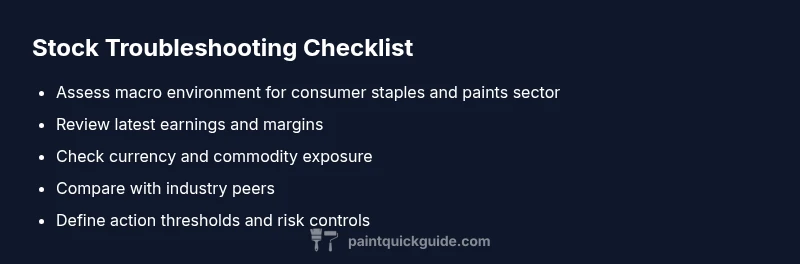
Create a checklist: (1) review the latest quarterly results and management guidance; (2) compare margins and return metrics with peers in the paints sector; (3) assess currency exposure and raw material costs; (4) analyze cash flow quality and capital allocation. Gather independent analyses and consider alternative scenarios for demand, price competition, and regulatory changes. Document your assumptions and recompute key metrics under different scenarios to understand potential downside and upside. This method reduces reliance on headlines and rumor-based chatter.
When to act and how to set guardrails
Decide your action plan before prices move further. Define clear triggers: e.g., if earnings guidance deteriorates, if margin compression worsens, or if currency headwinds intensify beyond a defined threshold. Set position limits and stop-loss rules aligned with your risk tolerance. If you’re uncertain or uncomfortable with the complexity, it may be wise to consult a financial advisor or rely on a diversified approach rather than a concentrated bet.
Common investor mistakes to avoid
Avoid chasing recent momentum or blaming a single factor for stock movement. Don’t rely on second-hand rumors or sensational headlines. Be cautious with over-leveraged bets or concentrated exposure in a single sector. Maintain a documented plan, review it periodically, and adjust only when new, high-quality information becomes available.
Practical next steps and a closing note
Take away the most actionable items: (a) read the latest quarterly report in detail, (b) compare peers and macro indicators, and (c) set pre-defined triggers and risk controls. The path to clarity often comes from disciplined evaluation rather than reactionary trades. The key is ongoing monitoring and an evidence-based approach to determine if the stock’s risks have stabilized or if further downside is likely.
Steps
Estimated time: 60-90 minutes
- 1
Collect baseline data
Gather the most recent quarterly results, management guidance, and analyst notes. Note any changes in margins, volumes, and geographic mix. This establishes a data-driven baseline for comparison.
Tip: Create a simple one-page data sheet summarizing key numbers. - 2
Check macro context
Review consumer spending trends, inflation data, and currency movements that could affect paint demand and margins. Compare regional performance to identify where weakness is concentrated.
Tip: Keep a watchlist of macro indicators that historically impact the sector. - 3
Review company fundamentals
Delve into gross and operating margins, cash flow quality, debt levels, and capital expenditure plans. Look for consistency with guidance and any surprises in the latest quarter.
Tip: Focus on free cash flow and return metrics rather than earnings alone. - 4
Benchmark against peers
Identify 2–3 sector peers and compare margins, growth, and valuation multiples. A relative weakness may be a signal of industry-wide pressure rather than company-specific issues.
Tip: Use a simple peer comparison table to keep things objective. - 5
Assess valuation and sentiment
Evaluate whether the stock is trading at a discount or premium relative to history and to peers, considering sentiment indicators and Reuters/CB insights where available.
Tip: Balance valuation with risk factors; avoid chasing expensive stocks during hype. - 6
Define catalysts and risks
List potential upside catalysts (new product lines, price adjustments, market expansion) and downside risks (cost pressure, regulatory changes, adverse macro signals).
Tip: Assign likelihoods to each scenario to quantify risk.
Diagnosis: Stock price movement around Asian Paints stock appears unclear or negative despite ongoing business activity.
Possible Causes
- highMarket-wide volatility or sector rotation affecting consumer staples and paints stocks
- mediumCompany-specific signals such as earnings variability or margin changes
- lowCurrency exposure and raw material cost volatility impacting profitability
Fixes
- easyReview the latest earnings release and management commentary for guidance on margins, demand, and capital allocation
- easyCompare Asian Paints with regional and global peers to gauge relative strength/weakness
- mediumAssess macro indicators, currency trends, and commodity prices to understand earnings sensitivity
Your Questions Answered
What are the top macro factors affecting Asian Paints stock?
Macro factors such as consumer spending, inflation, and currency rates can influence the stock’s performance. Stay alert to shifts in demand patterns and regional growth dynamics that could alter earnings potential.
Macro factors like spending, inflation, and currency can move this stock.
How should I compare Asian Paints stock to peers?
Compare margins, revenue growth, cash flow, and capital allocation against sector peers. A stock might look weak in isolation but perform well relative to its competitors when macro conditions are unfavorable.
Compare margins and cash flow with peers.
Is a earnings miss always bad for the stock?
Not always. If management provides reassuring guidance and confirms favorable longer-term trends, the market may look through a single miss. Focus on the qualitative outlook and updated targets.
Misses aren’t always bad if guidance improves.
What should I do if the stock is highly volatile?
Use risk controls such as position sizing and stop-loss orders. Diversify exposure and avoid overreacting to every price swing, especially during earnings periods.
Use risk controls and diversify to manage volatility.
Should I seek professional advice for this stock?
If you’re unsure about macro implications or valuation, consult a financial advisor who can tailor a plan to your risk tolerance and time horizon.
If unsure, talk to a financial advisor.
What signals indicate a potential recovery or deterioration?
Signals of recovery include improving margins, confirmation of demand, and clearer guidance. Deterioration can show up through higher costs, weaker demand, or negative macro shifts.
Watch for margin improvements and clearer guidance.
Watch Video
Quick Summary
- Assess macro factors before stock-specific details
- Compare peers to gauge relative strength
- Track earnings guidance and margins for trend clarity
- Set predefined action triggers and risk controls