Benjamin Moore Paint Sizes: A DIY Guide for Homeowners
Explore Benjamin Moore paint sizes—from gallons to tester options—and learn how to choose the right quantity for walls, cabinets, and trims while budgeting and reducing waste.


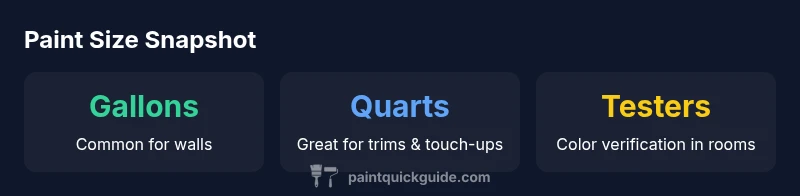
Benjamin Moore offers paint mainly in gallons and quarts, with tester/sample sizes available for color verification. For most projects, a gallon is a common choice for entire walls, while a quart serves well for touch-ups or small areas. Coverage depends on surface texture and finish, so always verify the product label for recommended coverage and plan extra for touch-ups.
Understanding paint sizes and Benjamin Moore options
For homeowners evaluating paint projects, understanding available sizes helps control cost and waste. In the Benjamin Moore lineup, sizes are designed to accommodate projects of different scales, from quick touch-ups to large room renovations. PaintQuickGuide notes that Benjamin Moore primarily offers gallons and quarts, with tester or sample sizes available to verify color before committing. This alignment with standard paint sizes makes it easy to estimate how much you need for a given room, a cabinet refresh, or an exterior upgrade. The choice between gallon and quart depends on scope, storage capacity, and the need for future touch-ups. Always review the product label for coverage guidance, drying times, and application methods, since these factors influence how many containers you’ll buy. By thinking through room dimensions, surface type, and the number of coats, you can reduce waste and avoid overbuying.
How to choose the right size for your project
Begin with scope and scale; categorize areas by size and finish. For large, uniform wall spaces, a gallon is typically more economical per square foot than multiple small cans, especially when applying two coats. For compact projects—trim, doors, or a single accent wall—quarts or tester sizes offer flexibility and lower risk of overbuying. If color flexibility is critical, use tester sizes to compare shades in the room’s lighting before committing to bulk paint. When calculating needs, think in terms of coverage guidance from the label and factor in priming, surface texture, and consecutive coats. If you anticipate future touch-ups from scuffs or repairs, consider purchasing an extra half-gallon to a full gallon for color consistency. Finally, organize your shopping list by finish and room to prevent mixing products and ensure consistent color across adjacent walls.
Impact of finishes on size and coverage
Finish affects perceived color and the amount of paint required. A high-sheen enamel may require fewer coats due to better coverage, while flat finishes can reveal application imperfections and demand more layers. Surfaces with holes, grain, or water-damaged areas absorb more paint, impacting how far a container goes. Light-colored paints often cover slightly differently than dark tones; it’s common to need an extra can when planning a dramatic color change. Priming can also influence size decisions: a good primer reduces the amount of topcoat needed and can enable using fewer gallons overall. If you’re painting over a stained or glossy surface, a bonding primer can improve adhesion and reduce wasted paint. By accounting for these finish and surface variables, you can select a size strategy that minimizes waste while preserving color accuracy.
Budgeting and waste reduction
Planning around sizes is a practical budgeting tool. Start with an estimate based on room dimensions, number of coats, and desired coverage. Use tester sizes to confirm color choices before committing to full gallons. Keep a running tally of your quantities by room and surface to avoid last-minute trips to the store. Retain all opened cans until the project is finished to prevent mismatched batches; label each container with the room, date, and coat number. Store leftover paint properly in a cool, dry area away from sunlight, and consider refrigerating unopened cans only if the manufacturer permits. If you end up short, it’s often easier to buy a smaller quantity in a nearby store than to stockpile extra, which can lead to waste. By staging purchases and using color-control strategies, you can stay within budget while achieving consistent, durable results.
Practical buying tips for Benjamin Moore
Before buying, check whether your local retailer offers tester packs that include multiple shades on swatch cards. Compare brand lines that are similar in color and finish to understand how they render under lighting in your home. Read product labels for coverage, drying times, and the number of coats recommended by the manufacturer. When possible, buy paint from the same batch or label to avoid slight color variations. If a color change is planned across rooms with different lighting, purchase paint in the same run and test in each room before finishing the project. Finally, consult store staff for color-matching or reordering advice, since transitions between rooms should look seamless.
Overview of paint size categories
| Size Category | Typical Use | Notes |
|---|---|---|
| Gallons | Walls/large surfaces | Common choice for whole rooms |
| Quarts | Small areas or touch-ups | More flexible, less waste |
| Tester sizes | Color testing | Not used for full rooms |
Your Questions Answered
Do Benjamin Moore paints come in sizes other than gallons and quarts?
Benjamin Moore primarily offers gallons and quarts with tester sizes; availability may vary by retailer for specialty lines.
Yes—gallons and quarts are standard, with tester sizes available, depending on the store.
How should I estimate how many cans to buy for a room?
Start with the room’s surface area, check the label’s coverage per gallon, and add a safety margin for coats and waste.
Calculate room area, check coverage per gallon, and add a little extra for coats and mistakes.
Are tester sizes always available for Benjamin Moore colors?
Tester sizes are commonly offered, but availability can vary by retailer and line. Ask ahead of time.
Tester options are usually available, but check with your retailer first.
Can I mix finishes in the same room without affecting color consistency?
Mixing finishes can affect color depth; test panels and ensure consistent coats and lighting before committing.
Test panels first to confirm how different finishes render in the room's lighting.
What about waste reduction when buying Benjamin Moore paints?
Plan by room, use tester sizes for color, and store leftovers properly to minimize waste.
Plan smart, test colors, and store leftovers correctly to cut waste.
“Understanding paint sizes helps reduce waste and keeps color consistent across projects.”
Quick Summary
- Buy gallon for large walls
- Use tester sizes for color testing
- Consider finishes and surface
- Plan for waste and touch-ups
- Store leftover paint properly