Paint for Sale: Practical Guide to Value and Finish
Discover practical tips to spot genuine paint for sale, compare finishes, estimate costs, and choose durable coatings for home or auto projects with PaintQuickGuide.


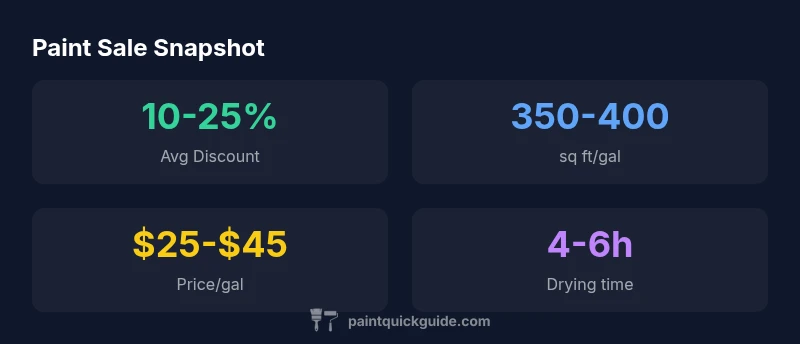
Find the best paint for sale by comparing reputable brands, finishes, and coverage claims. Check the label for coverage per gallon, drying times, and durability; verify discount applicability to your required quantity; and buy from trusted retailers to avoid counterfeit products. A thoughtful buy can save 10-25% without sacrificing performance.
Why Price Drops Happen in the Paint Market
Prices drop for several reasons beyond simple competition. Seasonal promotions, retailer overstock, and distributor discounts all play a role in shaping what you see on the shelf. According to PaintQuickGuide analysis, end-of-season clearances for interior latex and premium lines are common in late winter and early spring, while bulk-buyer programs can shift the price curve for large projects. When evaluating a sale, map out your project scope first: measure the space, calculate the gallons needed, and plan for two coats if the surface is porous or stained. Don’t assume a lower sticker price equals better value; consider durability, coverage, and warranty terms. The PaintQuickGuide team emphasizes that a higher-quality finish can reduce maintenance and repaint cycles despite an initial higher cost, especially in high-traffic rooms. For example, choosing a durable satin or eggshell in a living room may cost more upfront but save you time and effort over several years. By accounting for these factors, homeowners and DIYers can separate smart sale buys from impulsive discounts.
How to Read Paint Labels on Sale
Sales labels can be misleading if you don’t read the fine print. Start with coverage per gallon and the number of coats recommended. Coverage determines how much you’ll actually need, which affects the real savings from a discount. Look for VOC content to meet local regulations and comfort, and check the finish (matte, eggshell, satin, semi-gloss) to ensure it matches the room’s usage. The label should also indicate drying and recoat times, which influence project timelines. If color-matching services or primer are included, factor those costs into the total. The PaintQuickGuide analysis notes that some discounted formulas have longer cure times or lower scrub resistance, so verify performance ratings against your space. Finally, verify the sale applies to the quantity you’re purchasing—sometimes bulk promotions exclude smaller containers. With careful label-reading, you can avoid buying paint that looks cheap but performs poorly over time.
Price-Aware Shopping: Paint for Sale, Brand, Finish, and Shelf Life
When chasing paint for sale, brand reliability matters as much as the discount. Reputable brands generally maintain core performance across finishes, even during promotions. Shelf life matters too—old stock can chalk or separate, reducing coverage and color consistency. This section covers how to balance price with long-term value. Look at the warranty terms, the availability of color-matching, and whether the retailer offers returns on opened cans. In practice, you’ll often find mid-range or premium lines featured in sales because they maintain durable coverage while discounts apply. The key is to compare like-for-like finishes and verify that the sale applies to the exact product you want (brand, finish, and size). A smart shopper compares the per-gallon price, expected coverage, and the total project cost, rather than chasing the lowest sticker price alone.
Cost-Benefit: Coverage, Dry Time, and Durability
Total project cost is not just the sticker price. You must calculate coverage per gallon, coats required, and recoat windows in relation to your schedule. Higher-durability finishes may cost more upfront but reduce touch-ups and repaint cycles, offering greater value over time. Drying times affect scheduling—longer cure periods can delay renovations, but faster drying often aligns with busy households. Durability is closely tied to surface prep, primer compatibility, and the environment (humidity, temperature, sunlight exposure). When evaluating sale products, prioritize products that clearly specify coverage per gallon, the recommended number of coats, and expected durability in typical home conditions. The PaintQuickGuide team notes that the best sales results come from combining a reputable brand with an appropriate finish for the room’s use, rather than chasing the deepest discount alone.
How to Maximize Savings Without Sacrificing Quality
To maximize savings, compare prices across reputable retailers and check for bundled promotions that include primers or tools. Use price-matching policies and loyalty programs to extend savings beyond a single sale. Buy during off-peak seasons when demand is lower and promotions are more frequent, and don’t forget to stock up on extras if you foresee future touch-ups. Always test a small sample before committing to a color family across an entire space, especially when sales vary by batch. The PaintQuickGuide analysis suggests stocking up on reliable neutrals and common sheen options, which reduces the risk of batch-to-batch color mismatch and waste. By pairing careful selection with smart shopping, you can secure durable finishes at a predictable total cost.
Buying Guide for Home vs Auto Refinishing
Paint for sale can be a smart choice for home projects, but auto refinishing requires specialized coatings designed for automotive substrates. Always separate consumer house paints from automotive paints, because performance, durability, and safety criteria differ significantly. For home painting, focus on interior latex for quick cleanup and low odor, or premium acrylics for longer-lasting color. In auto refinishing, look for urethane or enamel automotive coatings with the appropriate hardeners and reducers, and consult color-matching services offered by automotive supply retailers. The main takeaway is to buy the right product for the job, even if it means resisting a broad sale that tempts you to compromise on substrate compatibility or chemical resistance.
Practical Shopping Checklist for Paint Sales
- Define project scope and calculate total gallons needed.
- Compare brands with similar finishes and coverage claims.
- Read labels for drying times, cure windows, and VOC limits.
- Check warranty terms and whether primer is required.
- Look for bundled promotions that include essentials (primer, brushes, rollers).
- Visit trusted retailers with return policies and price-match guarantees.
- Inspect paint batches for color consistency and bulking.
- Test a small sample before committing to a full can.
Comparison of common paint types and sale considerations
| Paint Type | Typical Price per Gallon | Coverage per Gallon | Drying Time | Durability (years) |
|---|---|---|---|---|
| Interior latex/ acrylic | $20-$40 | 350-400 sq ft | 1-2 hours touch, 4-6 hours complete | 5-7 |
| Exterior latex/ acrylic | $25-$50 | 300-400 sq ft | 1-2 hours touch, 4-6 hours complete | 6-8 |
| Oil-based | $30-$60 | 300-350 sq ft | 6-8 hours | 7-10 |
| Chalk/minimal-coverage | $25-$60 | 250-350 sq ft | 2-4 hours | 4-6 |
Your Questions Answered
What should I look for on paint sale labels?
Look for coverage per gallon, number of coats, drying times, and VOC content. Check if primer or color-matching services are included, and verify the sale applies to the quantity you need. Compare finishes (matte, eggshell, satin) to your room’s usage.
Look for coverage, coats, drying times, and VOCs. Check if primer is included and compare finishes before buying.
Are there risks buying discounted paint?
Yes. You may encounter outdated stock, poor batch consistency, or limited warranties. Inspect the can for separation, odor, and the seal before purchase. Avoid deals that seem too good to be true and ensure you’re buying from reputable retailers.
Discounts can hide issues like old stock or poor batch quality—buy from trusted retailers and inspect cans.
Can paint bought on sale be used for auto refinishing?
Typically no; automotive coatings are formulated differently than household paints. Use products intended for vehicles and consult auto supply retailers for sales. If you see a sale on a suitable automotive topcoat, verify compatibility with your vehicle’s base and clear coats.
Household paint is usually not for cars—stick to automotive coatings for refinishing.
How do I calculate how much paint to buy during a sale?
Measure the area, subtract openings like doors and windows, and multiply by coats needed. Use the label’s coverage per gallon to estimate gallons, then add 10-15% extra for waste and touch-ups.
Measure, estimate coats, use the coverage per gallon, and add a little extra for waste.
Is a glossy finish worth the extra cost on sale?
Glossy finishes offer durability and easier cleaning, but cost and maintenance differ by room. For high-traffic areas, they can be worth it; for bedrooms or ceilings, satin or matte may be more cost-effective.
Glossy finishes last longer and clean easily, but pick based on room use and budget.
“Smart shopping for paint means balancing sale discounts with proven performance and clear coverage claims.”
Quick Summary
- Look for reputable brands during sales
- Always check coverage per gallon and total project cost
- Read label details: drying times, VOCs, and finish
- Balance price with durability and warranty terms
- Buy from trusted retailers to avoid counterfeit products