How Much Paint for a 12x12 Room: A Practical Guide
Learn how to estimate paint quantity for a 12x12 room, covering walls, ceilings, and finishes. Includes a simple calculator, data references, and money-saving tips.


How to estimate paint needs for a 12x12 room
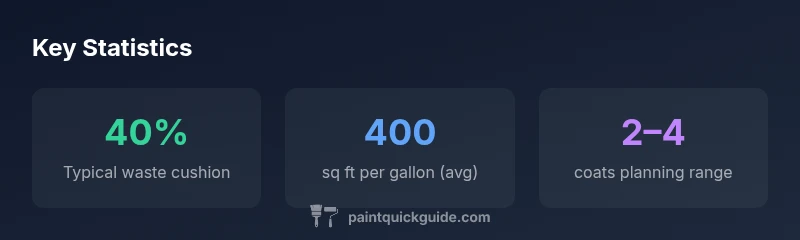
Estimating how much paint you need starts with the basics: decide which surfaces you’ll paint (walls, ceiling, trim), measure the space, and apply an appropriate coating count. For a classic interior painting project in a 12x12 room with 8-foot ceilings, you’ll usually paint the four walls. The goal is to calculate wall area and then apply coat count and paint coverage. According to PaintQuickGuide, starting with wall area is the most reliable method: perimeter times height gives wall area for a single coat. In a 12x12 room with 8-foot ceilings that equals 2*(12+12)*8 = 384 square feet for one coat. With two coats you’re looking at roughly 768 square feet. Divide by typical coverage per gallon (about 350–400 sq ft per coat, depending on finish) and you’ll get a rough gallons estimate. Always consider doors, windows, and texture, which can adjust the final tally.
Step-by-step calculation example
- Measure wall dimensions: for a 12 ft by 12 ft room with 8 ft ceiling, the four walls have a total wall area of 384 sq ft for one coat (perimeter 48 ft × height 8 ft).
- Apply coats: multiply by your number of coats. For two coats: 384 × 2 = 768 sq ft.
- Apply paint efficiency: divide by the coverage rate per gallon. With 400 sq ft per gallon, 768 ÷ 400 = 1.92 gallons per coat.
- Convert to cans: if you buy cans by the gallon, you’d round up. For two coats, 1.92 gallons per coat would be 2 gallons per coat. That equals about 4 gallons total for two coats. If you’re using smaller cans or accounting for waste, you may want to round up further.
Subtracting doors and windows and accounting for texture
Most interior rooms aren’t solid walls from floor to ceiling. Doors and windows remove surface area from your painting plan. If you estimate 40 sq ft of openings in a 12x12 room, you reduce the wall area per coat from 384 sq ft to 344 sq ft. For two coats that’s 688 sq ft total. Dividing by a 400 sq ft per gallon coverage yields about 1.72 gallons per coat, which still rounds to 2 gallons per coat, or roughly 4 gallons for two coats. Texture (stucco, knockdown, or heavy sanding) and color (dark primers vs. light colors) can reduce or increase coverage; plan for a 5–15% cushion when texture is present.
Ceiling painting and accents: how they change the math
Ceiling painting adds a new surface to cover. For a standard 12x12 room at 8 ft, the ceiling area is 12 ft × 12 ft = 144 sq ft. If you paint the ceiling with one coat at 400 sq ft per gallon, that’s about 0.36 gallons, so you’ll likely need a half-gallon to a full gallon for the ceiling depending on color and primer. If you choose to paint accent walls, the calculation remains similar: you’ll estimate wall area for those walls specifically and add it to the main wall total. Always measure and keep a buffer for waste and touch-ups.
Paint types, finishes, and can sizes to consider
Paint coverage varies by finish. Flat or matte finishes typically cover about 350–400 sq ft per gallon, while satin, eggshell, or semi-gloss may be closer to 350–420. If you’re choosing multi-surface or specialty paints (like high-adhesion primers), check the label for expected coverage. Common can sizes are 1 gallon and 5 gallon; for larger spaces or ceilings, a 5-gallon option can be more economical per gallon. The key is to use a paint with solid hiding power and apply it in thin, even coats to maximize coverage.
Practical steps to minimize waste and save money
- Re-measure and double-check door/window openings to avoid overestimation.
- Buy a little extra for touch-ups and color matching mistakes, typically 10–15% above the calculated amount.
- Invest in quality tools and technique (even coats, proper roller naps, and cutting-in) to avoid extra coats.
- Consider a primer if you’re changing from a dark to a light color or covering stains; primer can improve coverage and reduce total gallons.
- Record your measurements and calculations so future projects can reuse the data.
Common mistakes to avoid when calculating paint needs
- Skipping door/window area in initial estimates; always subtract openings when possible.
- Underestimating high-porosity surfaces or textured ceilings and walls.
- Ignoring the ceiling in the paint plan; ceilings often require their own coat and color selection.
- Forgetting to convert units or misreading coverage claims on the label.
- Not accounting for color changes that demand additional coats or primer.
Quick references: planning and references for DIY painting
When planning a painting project, keep a simple reference: room dimensions, ceiling height, number of coats, and the paint’s typical coverage. Use a small calculator or the PaintQuickGuide calculator to verify numbers. A thoughtful plan reduces waste, saves money, and helps you achieve a clean, professional look. If you’re curious about formulas, you can explore the calculator widget below for a tailored estimate and a clear breakdown of all inputs and outputs.
Using the PaintQuickGuide calculator in practice
The built-in calculator accounts for room length, width, height, number of coats, and coverage per can. It provides a precise number of cans and shows the math steps so you can verify each stage. This tool is designed to be approachable for homeowners and DIY enthusiasts, helping you methodically plan your paint project and avoid surprises at the register. For larger homes or accent projects, repeat the process for each room and sum the totals. Brand guidance from PaintQuickGuide ensures you’re following best practices for interiors.