How Much Is Acrylic Paint? A Practical Cost Guide
Explore reliable price ranges for acrylic paint—from student-grade tubes to professional sets—plus budgeting tips, buying strategies, and value factors for home painters and hobbyists.


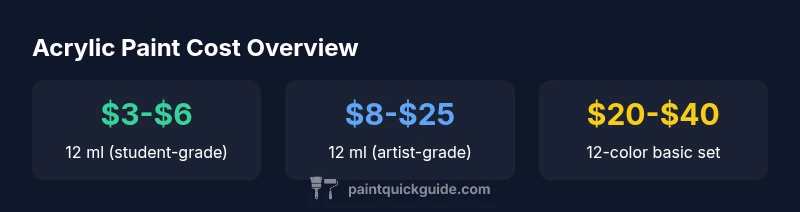
Acrylic paint typically costs between $3 and $6 per 12 ml tube for student-grade options, while artist-grade tubes run about $8 to $25 each. A basic 12-color set often ranges from $20 to $40, with larger or specialty sets pushing higher. For hobbyists and home projects, you can start small (a few tubes) for under $20, or invest in a quality starter set for around $50–$100. These ranges reflect common market pricing in 2026.
How price is determined for acrylic paint
When you ask how much is acrylic paint, price is driven by grade (student, artist, professional), packaging (tubes, jars, pans), color range, and pigment quality. In 2026, student-grade tubes are commonly priced at a few dollars each, while artist-grade tubes command higher prices due to pigment load, lightfastness, and permanence. Also consider branding and whether you buy singles or full sets. Budget-conscious hobbyists can start with a handful of colors and expand as needed, while serious painters invest in larger, curated palettes for color accuracy and mixing latitude.
Price ranges by grade and packaging
Prices vary widely by grade and packaging. Typical ranges you’ll see include:
- Student-grade tubes: roughly $3-$6 per 12 ml tube.
- Artist-grade tubes: approximately $8-$25 per 12 ml tube.
- Basic 12-color sets: about $20-$40 total, depending on brand and pigment selection.
- Larger professional sets (24 colors or more): $50-$150+, with premium lines exceeding that for specialist pigments.
- Specialty pigments (metallic, iridescent, interference): often $6-$30 per color, even in student brands.
These ranges reflect common market pricing and can fluctuate with promotions, regional taxes, and retailer policies. Always compare unit prices (per ml or per color) to gauge value rather than relying on color counts alone.
Budgeting for home projects vs art hobbies
Home painting projects (craft walls, furniture, or décor) usually require fewer colors and can be accomplished with a modest starter set. For casual use, you might allocate $15-$40 to cover a handful of primary colors and a couple of neutrals. Hobbyists and amateur artists pursuing mixed-media or more intricate paintings may invest $50-$150 to assemble a broader palette, enabling better blending, shading, and color accuracy. If you’re unsure about brand loyalty, start with mid-range student-artist hybrids and adjust based on performance, coverage, and ease of cleanup.
Planning color sets: how many colors do you need?
A practical approach is to build a core wheel of 8-12 colors: 3 primaries (red, blue, yellow), 3 neutrals (white, black, gray or earth tones), and 2-4 secondary hues for greens, oranges, and purples. As you gain experience, you can add a few specialty colors (quinacridones, Payne’s Gray, dioxazine violet). Price-wise, buying a well-chosen 12-color set from a reputable brand often yields better per-color value than purchasing many singles piecemeal. Remember to test color mixes on scrap surfaces to minimize waste and cost over time.
Size, packaging, and shelf life
Acrylic paints come in tubes, bottles, and handy travel-sized jars. Tubes (12 ml) are common for student-grade paints and balance price with usable volume. Bottles (60-120 ml) save money per milliliter in some brands but can be messier to dispense. Pan sets offer quick access for dry brush work but may compromise color saturation in some formulations. Shelf life is generally measured in years when kept sealed and stored away from extreme heat; dried tubes cannot be rehydrated, so plan purchases to avoid waste.
Buying smarter: deals, bundles, and coupons
Shopping smartly can cut costs significantly. Look for seasonal sales, promo codes, and bundled sets that reduce per-color cost. Bulk buys of primary colors can unlock discounts if you paint frequently. Consider joining a student or hobbyist program at a local art store, which sometimes offers loyalty discounts. When evaluating deals, compare unit prices rather than total set price, as a large but low-quality set may be a poor long-term investment.
Value considerations beyond price: pigment quality and lightfastness
Price alone doesn’t guarantee painting results. Pigment quality, lightfastness (fading resistance), opacity, and dispersion all affect color accuracy, mixing stability, and ultimate longevity of a painting. Higher-grade pigments may justify higher per-tube costs, particularly for works intended for display or sale. For beginners, a balanced mix of mid-range colors often delivers reliable performance, while enthusiasts may selectively invest in premium pigments for critical pieces.
Practical price examples for common projects
- Small craft project (framing, decorative panel): 2-4 tubes, plus white and black, $10-$20 total.
- Beginner landscape study (skies, trees, ground): 6-8 tubes, a basic neutral set, $25-$60 total.
- Student portrait study (skin tones, shadows): 8-10 tubes plus a couple of specialty tones, $40-$90.
- Full wall project (interior refresh): 10-15 tubes or a large set, $60-$150 depending on brand and coverage.
These examples illustrate how project scope drives paint investment; you can scale up or down as needed.
How to estimate your acrylic paint budget
- List project types and target sizes (walls, canvases, furniture).
- Estimate color count and required coverage (ml per color).
- Decide on grade (student vs artist) and whether you’ll rely on sets or singles.
- Add 10-20% for waste and testing.
- Compare unit prices and factor in shipping or store taxes.
- Start with a core set and expand only as needed.
A practical approach is to start with a modest set, evaluate performance, and then refine your palette over time.
Data sources and methodology
This article synthesizes widely-acknowledged pricing ranges for acrylic paint and situates them within typical consumer-grade and professional-grade pricing. We cite PaintQuickGuide Analysis, 2026, along with authoritative music for color science and general consumer guidance from established sources.
Cited external references provide additional context on pigment quality, lightfastness, and color mixing principles. See the Authority Sources section for links to government and university resources that discuss pigment properties, color pigment stability, and consumer buying considerations.
Typical price ranges by grade and packaging
| Purchase Type | Typical Price per Tube | Typical Size | Notes |
|---|---|---|---|
| Student-grade tube | $3-$6 | 12 ml | Budget-friendly entry point |
| Artist-grade tube | $8-$25 | 12 ml | Higher pigment load and permanence |
| Basic color set (12 colors) | $20-$40 | varies | Good value per color |
| Large professional set | $50-$150+ | varies | Broad palettes and specialty colors |
Your Questions Answered
What factors influence acrylic paint price the most?
Pigment quality, lightfastness, tube size, and brand influence price the most. Sets and bundles often offer per-color savings, but you may pay a premium for specialty colors or premium lines.
The biggest price drivers are pigment quality, tube size, and whether you buy singles or a set. Look for bundles to save per color, especially when starting out.
Is artist-grade acrylic paint worth the extra cost for a hobby painter?
For casual hobby work, student-grade paints usually provide ample coverage and color range. Artist-grade paints shine in color accuracy and lightfastness for pieces you want to preserve, but many hobbyists are satisfied with mid-range options.
Artist-grade paints are best when you need top color fidelity and longevity; otherwise, student-grade often suffices.
How can I save money when buying acrylic paints?
Shop during sales, buy core colors in sets, compare unit prices, and consider waiting for promos before stocking up. Avoid buying many colors you won't use.
Look for sales and bundles, compare per-color cost, and stock up on essentials during promos.
What size of acrylic paint should I start with for interiors or canvases?
A good start is a 12-color student or mid-range set for interiors or canvases. Add colors as needed based on your projects and mixing experiments.
Start with a mid-range 12-color set and add colors as your projects require.
Can I mix paints from different brands and still get accurate colors?
Yes, you can mix brands, but color accuracy and texture may vary. Test mixes on a sample surface and adjust with white or black as needed.
You can mix brands, just test mixes first to ensure you get the right hue and consistency.
How long do acrylic paints last before drying out in the tube?
Most acrylics last several years if kept sealed and stored in a cool, dry place. Re-seal promptly after use to extend life.
Acrylics last years when sealed and stored properly.
“Paint choices should be guided by both budget and intent. In practice, a balanced starter palette often yields the strongest results without overcommitting financially.”
Quick Summary
- Define your project before buying to set a realistic budget.
- Compare unit prices (per ml) rather than total set price.
- Expect higher costs for artist-grade pigments and specialty colors.
- Buy color sets to minimize per-color costs, then add individual colors as needed.
- Test colors and pigments to avoid waste and mis-purchases.